
What is a freelancer?
Seems like a good place to start, is at the start.

I’ve already had someone email me to ask “Am I considered a freelancer if I’m a [their job title here]…?”. My response was pretty much “Do you call yourself a freelancer?”
There are going to be lots of new terms we unpack over the coming weeks/chapters/months. Seems like “Freelancer” is a good place to start as any.
Because actually this is a more complicated and important topic that you might think.

What is the definition of a freelancer?
Let’s start with the cliched etymological of the word “freelancer”.
The origins of the word “freelance” is often attributed the concept of a medieval mercenary who would fight for whichever nation or person paid them the most. Early evidence of the word appears in Sir Walter Scott’s novel, Ivanhoe from 1819:
"I offered Richard the service of my Free Lances"
and in The Life and Times of Hugh Miller, by Thomas N. Brown in 1809:
"Hugh Miller was a loyal combatant, not a free lance"
After which, the term mutated to refer to politicians without political affiliations, and then associated to independent writers and journalists, not employed by a newspaper, but free to write for whom they wish. Today - “freelancer” might conjure up ideas of flexibility, freedom, future-of-work, five-hour-working weeks, fiverr… other f-based alliterations.
The suffix “free-” here means “free from affiliation” not “free as in beer”. Free thinking. Free spirit. Free wheeling. Nothing to do with how much something costs.
Whilst I love the notion of having agency, I like less the connection back to “mercenary”, or working for the highest bidder.
Not least because most people don’t choose to go freelance for the cash, and the reality couldn’t be further from the truth for most. It’s not like most freelancers have clients knocking down the door, and we’re fighting them off with our metaphorical lances, as they bid for our attention. £350/day! No, £450! £500! £2000! (Can you imagine?)
But unfortunately, the idea has stuck - that many freelancers are doing the work for the cash. There’s no loyalty, no commitment, no sticking around - it’s just grab the money and run. And in return, an attitude towards freelancers that we’re just money-grabbing, don’t care who we work for, what work we do - it’s all about the moolah.
But what does freelancer actually mean? What is the formal definition?
Let’s start with Google, which sources from the Oxford English Dictionary:
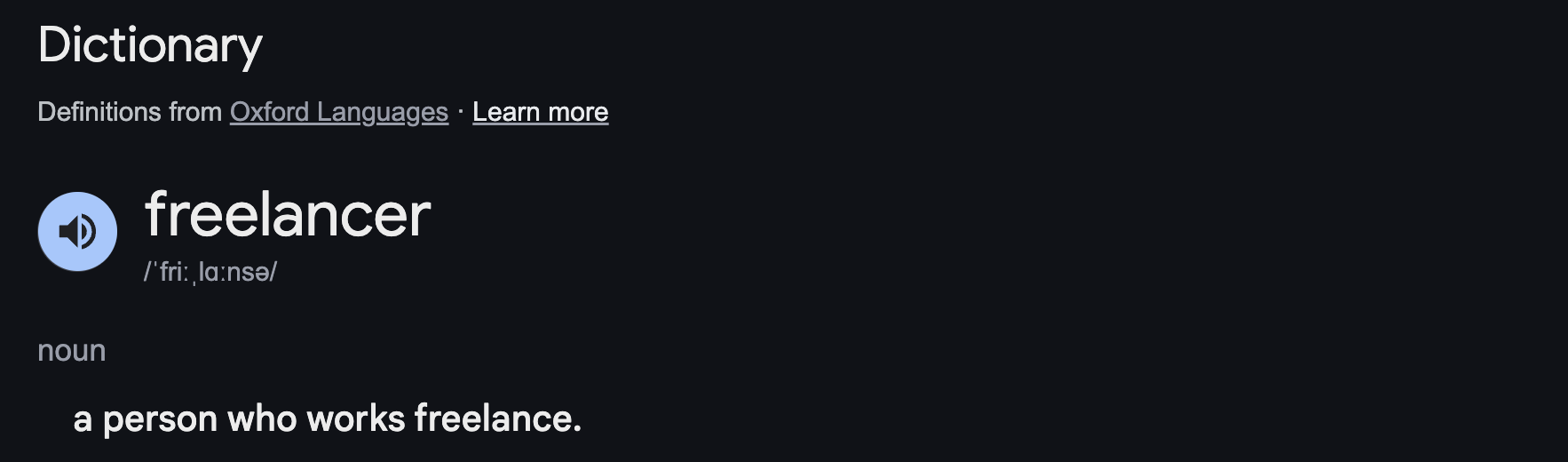
Thanks Google. Really helpful.
Let’s try Cambridge instead:
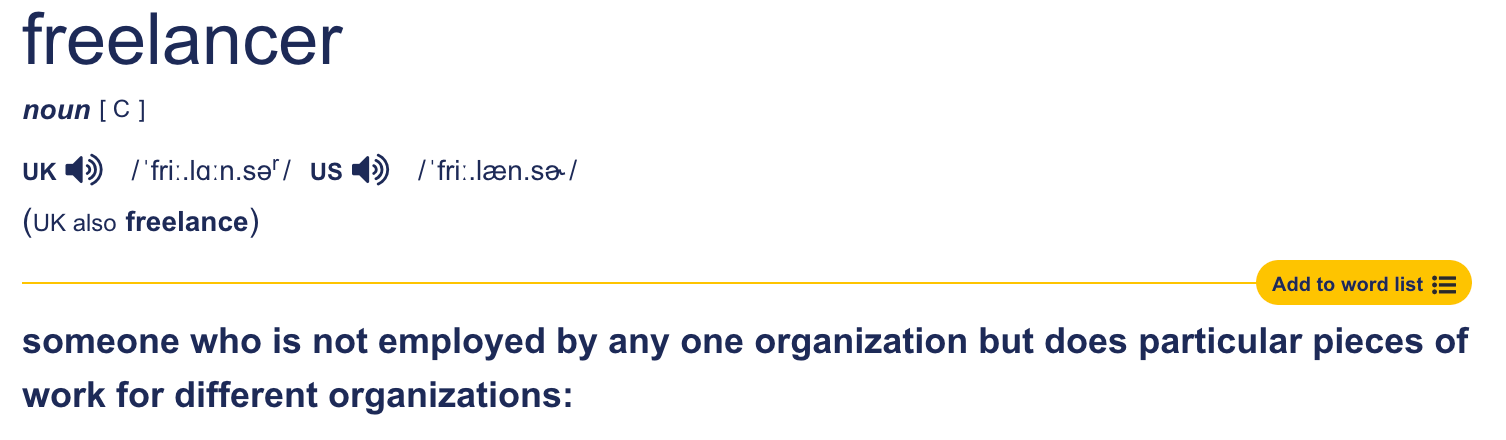
OK - getting somewhere, but my plumber is not employed by any one organisation, and does work for different people - but generally we wouldn’t call him a freelancer, would we? Locum doctors and nurses will often Work temporary shifts across different locations and employers, but we don’t call them freelancers. Someone with multiple jobs, perhaps a bar job in the evening, a shift in a shop, and picks up some labouring work on weekends - would we call them freelancers?
Perhaps the answer is ‘not employed’ - are freelancers unemployed?
Ah, _self-employed_ I hear you shouting from the comment section.
I think we’d all agree that freelancers are self-employed, right?
Defining self-employment
Self-employment is a fairly well-defined term, as far as tax and rights are concerned. Generally in the UK, we have three employment status: “Employees”, "Workers” and “Self-employed”.
Gov.uk says: “A person is self-employed if they run their business for themselves and take responsibility for its success or failure. Self-employed workers are not paid through PAYE, and they do not have the rights and responsibilities of an employee.”
But wait… how many of us freelancers sometimes are forced to be paid via PAYE due to IR35 or Umbrella companies? Does that mean you’re not a freelancer?
And… to further complicate matters, if you’re a limited company director, technically you’re an employee, and not classified as self-employed. Does that mean you’re not a freelancer?
Let’s come at this from the other angle then. Are all self-employed people freelancers?
Absolutely not.
As of March 2025, the UK had approximately 4.2 million self-employed individuals, according to the Office for National Statistics. Unfortunately, that number generally excludes limited company owners, so the actual number of people who run ‘single person businesses’, as either a sole-trader or single-person limited company, is higher. As of 2024, approximately 44% of the 2.06 million active limited companies in the UK are single-employee firms—meaning they have just one employee, typically the director themselves - which is just under 900k. So, for the sake of simple maths, let’s say 5m “self-employed-including-those-who-are-single-person-company-owners”.
We’ve already spoken about tradespeople, many laywers are self-employed, taxi-drivers, shop owners, personal trainers, farmers, childminders, counsellors - there are so many forms of self-employment which we wouldn’t call freelancing.
So of that rough 5m… who are freelancers, and how many?
IPSE - probably the UK’s most significant body representing independent workers in the UK (self-employed and single-person-business owners, etc), define freelancers as so:
“Freelancers are a subsection of the solo self-employed population who are working in the top three highest skilled occupational categories (SOC1 to SOC3).”
Catchy.
SOC codes (Standard Occupational Classification codes) are a system used in the UK to classify jobs based on the kind of work people do. They’re a bunch of four digit codes which try to define every possible job, for example:
5443 – Floral arrangers and flower decorators
9272 – Road sweepers
3414 – Dancers and choreographers
7113 – Telephone salespersons
1136 – IT Project and Programme Managers
2136 – Programmers and Software Development Professionals
3421 – Graphic Designers
Ah, we can see a few of these (those starting with 1, 2 and 3) are where some of our freelancers might likely live. And that’s what SOC1 to SOC3 means. Freelancers are likely to be doing work in the top three groups:
SOC1 – Managers, Directors and Senior Officials
SOC2 – Professional Occupations
SOC3 – Associate Professional and Technical Occupations
Of course, even this isn’t a perfect definition - Virtual or personal assistants would be classified as “4215”, for example.
But, we’re getting somewhere. A subset of the solo-self-employed (but not always self-employed) working in the top three SOC codes (but not always in the top three).
What about contractors?
“It’s not a freelance job if you’re asking them to work on site”
“That’s not a freelance role, that’s a contractor”.
“Looking for a contractor”. “Looking for a fractional”. “Looking for part-time”.
“FTC”, “Temp”, “Gig worker”
Some people will make a differentiation between a ‘freelancer’, a ‘contractor’, a ‘consultant’, and I’ve seen plenty of well-meaning articles and posts which determine clear (but frankly wrong) definitions of each of these terms, as if they’re clearly distinguishable.
Most commonly a “contractor” might be defined to be someone who works full-time for a single client on-site, whereas a “freelancer” has multiple clients at once and has their own premises. But that former definition reads like “employee” to me, and we all know we’ve worked plenty of times as a freelancer where we only have one client, and in the client’s offices.
But does it actually matter?
If you’re a freelancer vs a contractor vs self-employed vs consultant vs entrepreneur vs business owner vs independent vs…. Does it make a difference?
Legally no. And the reality is that you can move between different forms of work, different models of work quite fluidly.
Freelancer isn’t consistently, legally or commonly defined. So anyone who tells you what is and isn’t freelancing, feel free to ignore them, or point them to HMRC’s tax code, and ask them to show you where that phrase appears.
You’re either a sole-trader (self-employed), a limited company director (technically employed), an employee, a worker, or perhaps all of the above.
If you want to call yourself a freelancer - because you identify as that, because its a term which your industry or sector uses as a shortcut to describe a way of working, because it’s what you google on to find work, and what drop-down and radio-buttons you use to sign-up to Worksome on, then good for you.
If there’s one consistent truth about freelancing, it’s often a sense of wanting to design work around your needs and motivations - so you get to call yourself whatever you wish - Mr Tomato Giraffe.
But for the sake of a useful working definition, here’s my definition:
“A SOC1-3 professional, working independently of any single employer, providing services in return for non-salaried pay without the protections of employment for the majority of their income”.
No it’s not perfect, and no it doesn’t really matter.
By IPSE’s reckoning (because remember, there’s no legal definition, therefore no statistical data on this), that’s around 46 per cent of the overall “solo self-employed“ population, so roughly… between 2m people.
And you can see, from this LONG exploration, the fact we don’t really know a) how to classify freelancers and therefore b) how to count how many there are and c) that people can be both freelancers and not freelancers in the same day, plus d) huge numbers of people who will do additional work above and beyond their employment - the scope of the audience is… complicated.
Freelancer or business owner
In recent years, I’ve seen more and more people make distinction between “freelancer” and “business owner”. Again, both sole-traders and limited companies are registering with HMRC as running a business - so all freelancers are business owners.
But the distinction I think that many are trying to make (and often, it’s coaches selling freelancing courses who make this point) is around mindset. “You’re not just a freelancer, you’re building a business! Think like a business owner!”
Whilst I will agree that mindset is hugely important, and recognising that you are running a business is essential, for many reasons which we’ll come to - I still see this as yet another artificial distinction. Freelancers are business owners.
Freelancer as a negative
The term “freelancer”, also, unfortunately, has a fair amount of negative baggage attached to it.
As we touched upon above, there can often be a sense of freelancers being expensive, flaky, lacking in commitment, only in it for the money.
Whilst there may be many freelancers who are these things - to generalise about 2m people is just rude and wrong.
Secondly, freelancing can often be seen as ‘not a real job’, perhaps as many find themselves freelancing between perm roles if they’re unable to find work, many do it in evenings and weekends, many do it to top up their income, rather than it being the primary way they work.
Many who do freelance often find it hard to return to perm employment, facing prejudicial attitudes towards their career history - 3 or 4 years of freelancing can often be seen as a “career break” or not real experience - despite (and we’ll probably come on to this in later chapters) it probably being some of the best possible experience for any worker to have.
And then there’s the “outsider” aspect - all too often, freelancers will be on the outside of the core team, not integrated effectively into communications or bonding, not around long-enough to build relationships, not seen as a real part of the team, sometimes even looked down upon - perhaps for the reasons above, perhaps resentment that they are seen to be getting “paid more”, which again, we’ll touch upon in future chapters, perhaps resented because they had to be brought in because the team “wasn’t good enough” or didn’t have the skills to do the job themselves?
Sometimes freelancers are forced to be on the edges, with businesses fearing the wrath of being caught ‘inside IR35’ if you invite a freelancer to drinks or the xmas party. All nonsense of course, but often held up as a justification for treating the freelancer as different.
“Freelancer” also often conjures up massive marketplaces like fiverr and upwork - where you can buy a logo for £25 or a blog post for £10 - a commoditised race to the bottom, where yes, there are many talented people, but equally, many without years of experience, offering their work by undercutting others - and many hirers have poor experiences, which for them further cements that “using freelancers doesn’t work for us”, rather than the more nuanced “the freelancers we worked with didn’t deliver to our expectations”
The other challenge with the massive marketplaces, commoditisation and almost-frictionless nature of finding and hiring freelancers in this way is the Tinderisation of workers. It feels effortless to find-another-freelancer, just swipe again. Why do you need to worry how you’re treating them, if there’s 100 others in the queue lining up to work with you? They’re a resource, not a human. Swipe swipe, discard, swipe. The oversupply and seemingly over-saturation of the market of freelancers in some categories means freelancers can be treated like less than human.
We have no employment rights, very few legal rights, very few moral rights, and this is a problem.
So, in so many ways, the term “freelancer” can comes with lots of issues, baggage and attitudes which are unhelpful.
You can understand why many individuals will reject the term “freelancer”, and look towards other terms.
Personally, I prefer the term “independent”.
So, defining “freelancer” is hard - but perhaps it doesn’t matter, or perhaps it really does.
And in lots of ways, I think there’s a case to be heard that ‘freelancing’ needs a significant rebrand, or perhaps the solution is to define yourself in another way entirely.
No employed individual responds to the age-old question at a party “Hey, what do you do?” by saying “I’m an employee” - yet, so many of us will say “I’m a freelancer”.
Freelancing is a way of working, not the work itself.
You’re a designer, a developer, an illustrator, a carpenter, a strategist, a copywriter, an AI specialist, a bookbinder, any number of things. Freelance is the prefix, not the story.
Yet - at the same time, there IS something powerful about identifying as a freelancer. And I use the word “identify”, because I think it’s right in this context. If you identify as a freelancer, or self-employed, or independent - whatever label you choose to use, you’re creating a connection with many many many others who also identify in the same way.
Belonging is important.
And being part of something bigger is important.
I don’t think any employees would wear a t-shirt that says “Employee”.
But I know plenty of us, who would proudly wear a shirt that says “Freelancer”.
Because it’s more than just a label.
It distills the hard work, the steep-learning curve, the hours chasing invoices, the crushing defeat when not getting a project, the massive high when you win a new client, the sense of achievement of doing something yourself, the connection and bond you have to all of the other freelancers who _just get it_.
The only defining factor I think we can agree on, is that freelancers are soloists.
And doing it alone sucks.
So being part of a larger group of people matters.
And for me, that’s what matters most about the definition - that it includes you in a larger community of people doing similar things, and that can help you feel a little less on your own.
What do you call yourself?
Join in the conversation. Leapers is a collective project, built upon the voices of thousands of freelancers - share your take on the question of definitions, terms and concepts of freelancing.
' A SOC1-3 professional, working independently of any single employer, providing services in return for non-salaried pay without the protections of employment for the majority of their income' I'll be sure to quote this in my PhD Matthew!
This means that the A-Team are freelancers!
Great post, and also seems to chime/overlap slightly with a similarly recent thinking by The Imma Collective? https://immacollective.substack.com/p/freelancer-solopreneur-entrepreneur